Posts

Stable Diffusion User Interface for Java

Image
Happy to share my recently developed GUI application built entirely in Java! The app, called SDUI4J , serves as an intuitive platform for Text-To-Image and Image-To-Image generation, seamlessly integrated with Stable Diffusion APIs .  Using JavaFX along with FXML , I've crafted a modern and structured GUI, ensuring a user-friendly experience while tapping into Java's full potential in the realm of Generative AI. I'm passionate about discovering Java's capabilities in the field of AI, and this project is a testament to that. I'm excited to continue exploring the convergence of Java and AI. If you're interested in learning more about this project or exploring potential collaborations, feel free to reach out. Let's drive Java forward in Generative AI together! 

[Event] Live Coding: Functional Refactoring in Java

Image
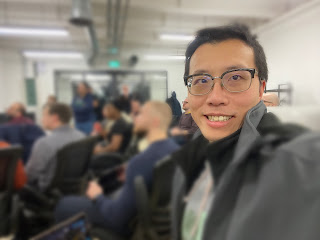
Just experienced a fantastic moment at the deep-dive live coding session hosted by Matias Salerno at Auto Trader UK this evening. We were watching the live transformation of imperative legacy Java code into a concise and declarative Functional Programming style. Another interesting thing is how participants with background of JS and Python grasped more OOP concepts in Java during the session.  Matias Salerno (right) Kudos to Manchester Java Community for organising such a hands-on session, and not to mention, the delicious refreshments!

Event: Manchester Coding Dojo

Image
Coding Dojo Thank you to Codurance for organising Coding Dojo to learn Test Driven Development . We did not only taste TDD and JS but also explored Copilot , Team Collaboration, Project Management, Methodology, etc. Networking seemed endless after the talk. No wonder why this city became a hub of talents.  Outside Department Bonded Warehouse Inside Department Bonded Warehouse

Monty Hall Problem Simulation

""" This is a simulation of Monty Hall Problem. https://en.wikipedia.org/wiki/Monty_Hall_problem Suppose you're on a game show, and you're given the choice of three doors: Behind one door is a car; behind the others, goats. You pick a door, say No. 1, and the host, who knows what's behind the doors, opens another door, say No. 3, which has a goat. He then says to you, "Do you want to pick door No. 2?" Is it to your advantage to switch your choice? """ import random NUM_DOORS = 3  # three doors in the game MAX_ROUND = 10000  # number of rounds for statistics change_win_count = 0 for _ in range (MAX_ROUND):   # randomly to put a car behind a door   car_door = random. randint (0, NUM_DOORS - 1)   # the player firstly selects a door   player_first_guess = random. randint (0, NUM_DOORS - 1)   # the host opens another door without a car   host_door = random. choice ([       x for x in range (NUM_DOORS) if x != player_first_guess and...

Small Step, Giant Leap

Image
  Looms in Quarry Bank Check out these two antique looms displayed in Quarry Bank of National Trust  Although they look similar, the left one comes with a tiny gadget called Flying Shuttle. This small improvement dramatically increased the productivity over tenfold. John Kay might not have even imagined how much his invention would become a catalyst for the Industrial Revolution and have profound effects on the world history.  You know what? Keep dreaming, innovating, and moving ahead. You never know your next small step could be a giant leap for mankind.

Pluses and Minuses: How Math Solves Our Problems

Image
  Pluses and Minuses: How Math Solves Our Problems "Pluses and Minuses: How Math Solves Our Problems" by Stefan Buijsman is a thought provoking book about the role of Mathematics in our daily life. The book starts with examples of Google Map and Netflix to present that Maths is not only an abstract exercise in a classroom but also closely related with us everyday. Following that, it describes how human being interpret Maths and its development along the history in various cultures. The later chapters demonstrate about the history and applications of two advanced topics, Calculus and Probability. The last topic is about graph theory and explores its usage in navigation, streaming service, cancer treatment and social media. The last chapter is not only a conclusion but also rethinks the nature of Maths and how we correctly and mistakenly apply it in our daily experiences. While the book contains a few content describing Maths formula and theorems in this book, it primarily focu...

Event: Developer Productivity Engineering: What's in it for me?

Image
Manchester Java Community hosted another great session in Thoughtworks . The speaker is Trisha Gee , co-author of the renowned book Head First Java .  The speaker pointed out that the productivity of developers did not mainly come from individual developer themselves but from the organisation which offers productive environments or not. The factor includes work space size, quietness, privateness, any diversion or needless interruption. On technology side, productivity can be improved by consistency and reliability of builds. Very fast feedback can improve productivity and quality, thus increase revenue, reduce cost and improve brand. References: DEVELOPER PRODUCTIVITY ENGINEERING: WHAT’S IN IT FOR ME? The 2019 Tidelift managed open source survey results Peopleware: Productive Projects and Teams Software Productivity   The Goal: A Process of Ongoing Improvement Improve the Performance of Gradle Builds CI fanout Netflix Pursues Soft DevEx Goals with Hard DevProd Metrics using Te...